PCAP Certification Study Guide: Exam Topics and Preparation
By Testara Team
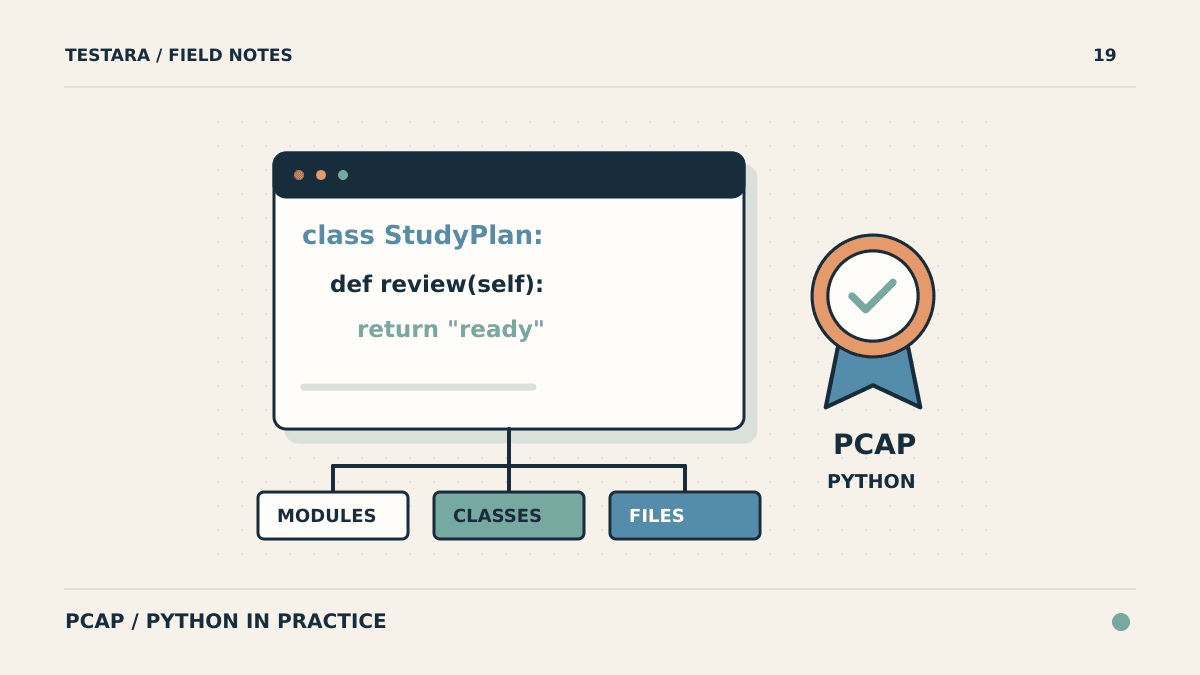
The PCAP certification is an associate-level Python credential from the Python Institute. Its active exam version, PCAP-31-03, assesses practical programming skills such as object-oriented design, modules, exceptions, strings, and file handling. Use the current syllabus as your study checklist: being comfortable with Python syntax alone does not show whether you can apply each objective.
This guide follows the official PCAP exam information and PCAP-31-03 exam syllabus. The Institute lists PCAP-31-04 as in development, so verify the exam version and objectives before you book.
What Is the PCAP Certification?
PCAP is the Certified Associate Python Programmer credential. It is intended to validate intermediate Python programming knowledge, including the ability to work with multi-module programs and apply object-oriented programming techniques.
The Python Institute lists no formal prerequisite. It recommends its PCEP entry-level credential as preparation, but your readiness depends on whether you can use the published PCAP objectives, not just whether you hold another certificate.
PCAP-31-03 Exam Structure
The current PCAP-31-03 information lists 40 items and a 65-minute exam, with a separate tutorial and non-disclosure agreement period. The exam can include single-select, multiple-select, coding, scenario-based, and interactive items. The published passing score is 70%; check the official page for current delivery and scheduling details.
| Syllabus section | Items | Weight |
|---|---|---|
| Modules and packages | 6 | 12% |
| Exceptions | 5 | 14% |
| Strings | 8 | 18% |
| Object-oriented programming | 12 | 34% |
| List comprehensions, lambdas, closures, and I/O | 9 | 22% |
The syllabus weights are useful for allocating review time, but they are not a reason to skip a lower-weight section. The exam may assess the objectives in different item formats, including code interpretation and programming tasks.
PCAP-31-03 Topics to Study
Modules and Packages
Practice importing from modules and packages, using aliases, and understanding how Python searches for modules. Review user-defined packages, __name__, __pycache__, __init__.py, and the distinction between a package structure and a directory tree. The syllabus also includes selected uses of the math, random, and platform modules.
Exceptions
Be able to trace try, except, else, and finally flow. Study exception hierarchy and branch ordering, raise, assertions, exception objects, and custom exception classes. Write small examples where you choose an exception type that communicates the failure clearly.
Strings
Review character encodings, Unicode code points, and escape sequences alongside everyday string operations. Practice indexing, slicing, iteration, comparisons, membership, and immutability. Know how methods such as split(), join(), strip(), find(), and index() behave, including what happens when a searched-for value is absent.
Object-Oriented Programming
This is the largest weighted section in the published syllabus. Practice defining classes and instances, using methods and properties, and explaining encapsulation, inheritance, superclasses, and subclasses. Be comfortable reading code that combines these features rather than memorizing isolated definitions.
Comprehensions, Functional Tools, Closures, and I/O
Write list comprehensions and compare them with loops. Practice defining lambdas and passing them to functions such as map() and filter(). Make sure you can explain what a closure retains from its enclosing scope. For file handling, review modes, streams, open(), closing files, reading and writing text or bytes, and working with bytearray buffers.
A Practical PCAP Study Plan
- Download the current syllabus. Turn every objective into a checklist and mark it as new, familiar, or demonstrated.
- Build a baseline. Write short programs that use modules, exceptions, strings, classes, and file operations without following a tutorial line by line.
- Prioritize your gaps. Give object-oriented programming focused practice because it carries the largest published weight, while keeping all five sections in your plan.
- Practice tracing and debugging. For each example, predict its output or exception before running it, then explain any difference.
- Use fresh practice questions. Review why each option is right or wrong, then return to the syllabus or Python documentation for unfamiliar behavior.
- Recheck the exam version. Before scheduling, confirm the active exam code, syllabus, format, language, and delivery rules on the Python Institute site.
Use small, original programs as evidence of progress: a package with multiple modules, a class hierarchy, custom exceptions, and file input or output can expose gaps that passive reading may leave hidden.
Official PCAP Study Resources
- PCAP certification page: current exam version, format, duration, and credential information.
- PCAP-31-03 exam syllabus: section weights and detailed learning objectives.
- Python documentation: reference material for language behavior and standard-library modules named in the syllabus.
- Python Institute learning resources: official training and preparation options. Check that a course or resource matches the current exam version.
Is PCAP Right for You?
PCAP can provide a structured target if you already know Python fundamentals and want to demonstrate broader programming skills. If you are still learning basic expressions, control flow, functions, and data structures, strengthen those foundations first and consider whether the recommended PCEP path fits your needs.
Treat the credential as one way to document knowledge, not a promise of employment or a substitute for projects. Choose it when its objectives align with the Python work or learning goals you have in mind.
Frequently Asked Questions
What does the PCAP certification cover?
The active PCAP-31-03 syllabus covers modules and packages, exceptions, strings, object-oriented programming, and list comprehensions, lambdas, closures, and file input and output.
Do I need to pass PCEP before taking PCAP?
The Python Institute lists no formal prerequisite for PCAP. It recommends PCEP as preparation, so compare the PCAP objectives with your current Python skills before scheduling.
Is PCAP-31-03 still the current exam?
The Python Institute currently lists PCAP-31-03 as active and PCAP-31-04 as in development. Check the official exam page and syllabus again before booking because exam versions can change.
Conclusion
Prepare from the official PCAP syllabus, build small programs around its objectives, and use practice questions to identify what needs another review. Confirm that PCAP-31-03 is still the version you will take before investing in exam-specific materials or booking.
Practice for the PCAP exam
Try Python certification practice questions and use the results to find topics for further review.
Browse Practice Tests